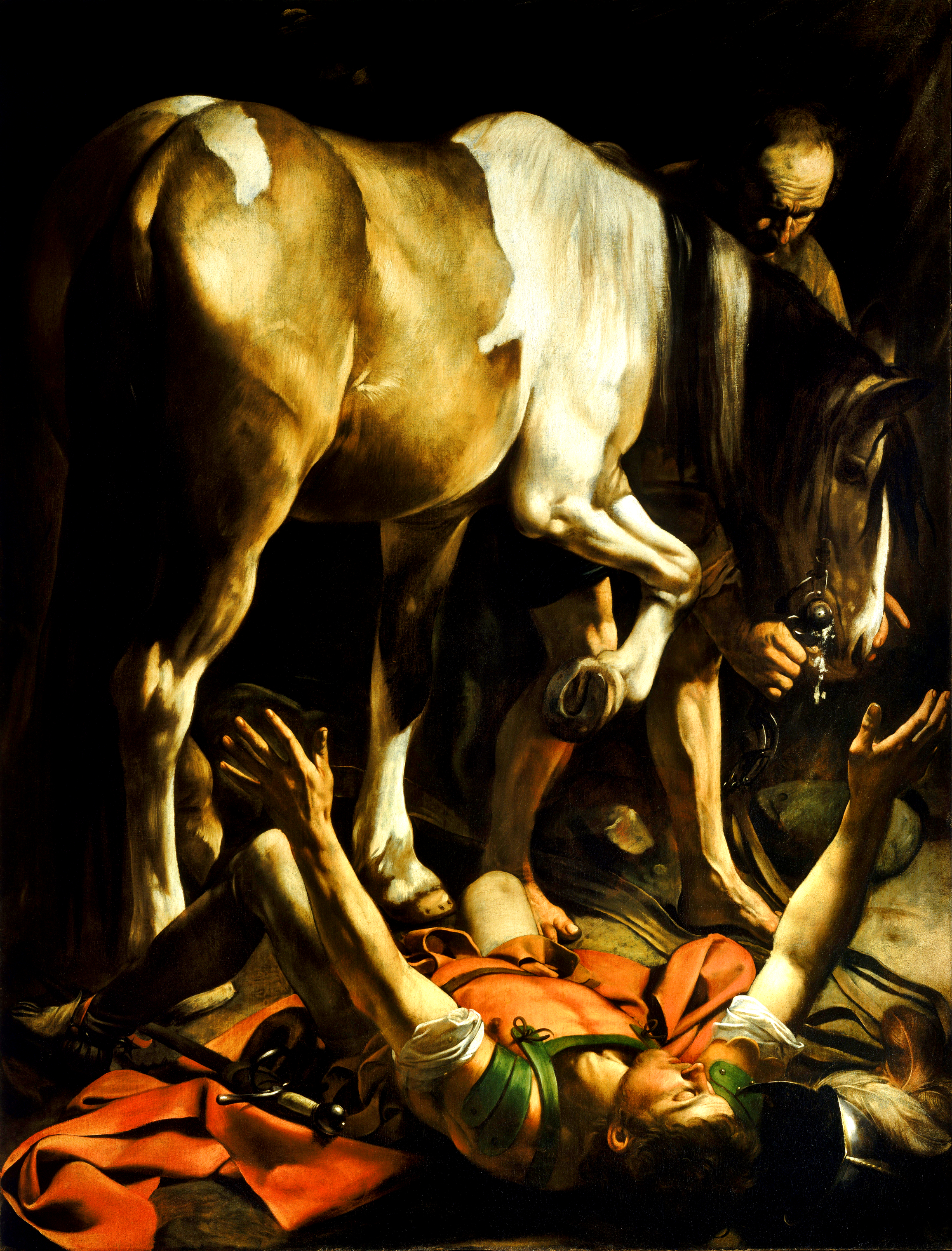
 After last month's retreat, which took place on the days during which we celebrated the conversion of St Paul, I have been eager to read about conversions to the Christian faith. I am currently reading two books, "The Road to Damascus" a collection of conversion stories compiled by John O'Brien, and another one, "Theology and Sanity" by Frank Sheed.
The first one tells of many paths different people took to arrive at Rome, and the second, of the role of intellect in our spiritual life. I happened to read these, as I commemorated the 13th anniversary of my first communion. (I know, how sentimental it sounds to be remembering dates like these!) After all, I waited almost seven months to receive communion after my baptism, and couldn't help constantly thinking that the craziest thing I have ever done was to convert to Catholicism. Reading these two, I was struck anew with an even greater marvel at the abundant grace behind each conversion.
From Theology and Sanity, I read Sheed's defense of the importance, if not necessity, of having solid intellect in order to love God:
"It would be a strange God who could be loved better by knowing less.
...
Love of God is not the same as the knowledge of God; but if a man loves God knowing little about Him, he should love God more from knowing more about Him; for every new thing known about God is a new reason for loving Him."
Indeed, reading each person's conversion story made me marvel anew at the great mercy of God who brought us home through the least expected path. In all, however, Reason was instrumental. I have been asked several times, to tell my conversion story, and each time, I discovered something new, yet another moment where grace surged in to 'lift' Reason where it could not rise to the occasion. Recently I realized that conversion is a work of a lifetime, that we are invited to keep "turning back to God" after every inadvertent fall, and that every 'new' truth I learn about God help me to grow in love and to fight for this Love once more.
Evelyn Waugh, the famous English author who wrote Brideshead Revisited (among other excellent works), wrote that he "lost" his Anglican faith through a well-meaning Anglican bishop who explained that none of the books in the Bible were written by their supposed authors and invited his students to speculate on the nature of Christ the way 4th-century heretics had. This experience convinced me afresh of the importance of having solid intellect to strengthen our faith; lest in our moments of weakness our will, the other human faculty, falters. He did however, have a high esteem for the supernatural efficacy sacraments of the Church, speculating that if he had been a Catholic boy in his childhood, "fortified" with the sacraments and securely watched over by someone sensible in a Catholic school, he would never have abandoned his faith. (Little did he know...)
"However learned you are in theology, nothing you know amounts to anything in comparison with the knowledge of the simplest actual member of the communion of Saints" -- Evelyn Waugh
Another person who found her way to the communion of saints was a self-proclaimed atheist journalist, Gretta Palmer. Her story really highlighted the struggle of an atheist to accept Truth like a sunshine through a small crack in an 'atheist cell'. Truth has this quality to shine from under the dirtiest facade. Palmer wrote of her "confusion" in her quest to perfect men; not being able to explain why it was not possible to socially engineer a perfect society, naively assuming that hostility towards one another can be cured as one treats as a physical malaise. "Original sin" was the answer given by a priest when she asked him. Her 'scientific' quest for the fons of 'goodness' took her to battle-weary soldiers, giving themselves completely in spite of all the suffering and behaving in utmost noble manner. Interested in social engineering? Palmer wrote that she had a fantasy of becoming Madam "Secretary of Social Evolution", but was soon disabused of this notion on her trip to China when, amidst great suffering and valor of the soldiers, she realized that the most 'useful' thing she could do was to pray for the soldiers. Once again, Reason rules and she soon ran into an inconsistency -- why pray, and to whom does one pray, if there is no God?
"When atheist scientists attempt to study man, they undertake an 'intellectual absurdity'. Man, studied as a creature separated from the God who is constantly communicating with him, can never be understood." -- Gretta Palmer
Reason alone does not provide meaning to one's life. Fulton Oursler, another whose story is featured in The Road, a playwright behind the radio program The Greatest Story Ever Told, lost his childhood Protestant faith and while being an agnostic, thought that science was the only true 'religion', until he concluded that they had "no head for synthesis [and] no heart for seeking a meaning in life." This reminds me of an anecdote told by Cardinal George Pell to an audience of (presumably Catholic) scientists about what "hell" possibly could be for scientists. It sounds something like this: a place where all facts could be known simply by looking it up on a book somewhere on its vast shelves, where all the instruments to measure any kind of thing or to observe any kind of phenomenon are available for use, where all the scientific unknowns could be found out by simply asking. And yet, there is no meaning behind all that. There is no reason to want to know why the number p is transcendent. No reason to know why space-time continuum is affected by mass. No reason to know how old the Universe is. No reason to know how many Universes are there. No reason to know anything at all, if God is not. Truly, speaking as someone who considers her profession "scientific", I am horrified at the prospect of ending up in such hell.
I don't recall exactly how I found my way to the Church, but there is always too much mystery for me -- I'd rather fall on my knees in thanksgiving than to analyze it -- but I'll end off this 'segment' of the Road quoting Fulton Oursler:
"Everyone who faces the blinding light of the Damascus road sees things in himself that he will never tell. On the other hand, I do believe that every man blessed with the gift of faith owes it to his fellow man to tell what he can of his conversion, in the hope that someone else may get from the story a glimpse, a little bit of help, and find for himself the same release."