Wednesday, October 31, 2007

Communion of saints

For many years, the Communion of saints is a Catholic concept that is probably one of the hardest things to understand for me, a convert. To me, from observing many cradle-Catholic friends of mine, the communion of saints means, roughly, praying to St Anthony for a certain kind of intention, St Jude to another kind of intention, going to novenas, visiting the shrines of our Lady for all sorts of special intentions, etc. What often came to my mind is a picture of old ladies clutching prayer cards and rosaries, and occasionally, physical penance carried out to 'bargain' with the saints for their intercession. Their piety amaze and move me, but really, is it necessary?

I suppose I did not much understand this because my life frankly, has not been one where much bargaining for divine intercession is needed. There were many ups and downs, but I trust that God knows better what's good for us than we do ourselves.

Fast forward to the present day, I share an apartment with a cradle Catholic from the Philippines, and made friends with many other cradle Catholics from traditionally Catholic countries. They expose me to these heretofore alien pious practices. And many intercessions, invocations, devotions, and Marian pilgrimages later, I realize that it has helped me form a habit to pray for other people's intentions and needs. I also realize that means I can ask many more people to pray for my intentions. It is strange for me today if there are nobody's intentions to pray for... and if friends ask me, a lowly member of the Church militant and a sinner, to pray for their intentions, why can't we turn to the saints and holy souls to intercede for us? For the petitions of the just surely carry more merit in heaven...

Through other means I have also 'discovered' the communion of saints. Since I started reading Catholic blogs, there have been so many new acquaintances made, and so many people and intentions to pray for. Two years ago, I found out that one of the twins (of Angry Twins) was about to enter the monastery and began praying for him. And the blogger formerly known as Moneybags, have also entered the seminary this fall. And the blogger who's praying for the safety of a baby in threat of being aborted. And the blogger who's praying that the San Diego fire may not harm a monastery nearby. There are many other examples through which I realize that the communion of saints is so REAL.

Today, for instance, I read a lovely story about Kate's grandfather who recently passed away and whom she remembered especially for his famous butter cinnamon toast. I don't know who Kate is, I don't know who her grandpa is, and I've never eaten cinnamon toast before... but from now on, I'll remember them in prayer whenever I eat cinnamon toast. Isn't the communion of saints beautiful?

Saturday, October 27, 2007

Rosary Widget

For the month of October, my contribution to Our Lady of the Holy Rosary is this little widget (official link here). Similar to the earlier aspirations widget, it is a Yahoo! Widget (not to be confused with widgets for blogs). It was this earlier widget that started a few requests coming my way, one of them is a request for a rosary widget as a prayer aid.

A few months after the request, I finally took a few hours on a Friday night to do it. Actually the real reason was because I had been home-bound and desk-bound for the last few days and personally had trouble concentrating in the praying of the rosary, which I normally say whilst travelling. Also, I keep giving away my rosaries to people around me, that it's time to use an electronic aid...


To start, simply click on the red beads. It will scroll through the prayers (no going back though!) and display a counter of Hail Mary's said.

Some features:

- Option to turn ON/OFF the illustration images
- Option to say mystery of the day (default) or your choice of mystery
- Option to switch between English & Latin

I've submitted this widget for public download at Yahoo! Widgets Gallery and it's still now under review. (I will update this post and the link when it goes live.) In the meanwhile, if you trust that I'm not going to run some malicious code on your machine, you can also download it here (UPDATE: link refreshed). If it helps you to pray better, it's enough reward! Feedback welcome.

UPDATE: I found an article that talks about how powerful praying the rosary is. It's not the only example, but it's good to remember especially if we slip into remission. Spread the rosary!

UPDATE #2: The widget now is ready for download from Yahoo! site. The link is here

Monday, October 22, 2007

Formula One 2007 season concludes

One of my favorite sports (well, sports to watch) is Formula One motor racing, which I started watching since 1998. It's mesmerizing at a glance, and upon learning further about the sports, one gains respect for its intricacy. A hundredth of a second may tip the balance towards victory, or defeat. It's one of the sports that combines precision engineering, performance calibration, strategy, teamwork and individual (the racer's) gumption. What's not to like about the sports?

Well, for one, this year has been a scandal-ridden one for McLaren-Mercedes (now renamed "Vodafone McLaren Mercedes"), from accusation of corporate espionage, to multiple possibilities of rules infringement such as using two sets of wet tyres and running on fuel with temperature higher than allowed. The stars of this sports don't seem to be as colorful as those of, say, soccer. Not that they are above bickering, or sometimes, less than honorable deeds like blocking a rival. But still...


This year's Drivers' Championship is won by Kimi Räikkönen, one of my favorite drivers since his days at McLaren, by just one point! What a race Interlagos was... he started the race as a Championship contender in third position. In brief, Alonso and rookie McLaren driver Lewis Hamilton tied for 2nd and 3rd at 109 points each, with Kimi at 110. More about this year's season here.

Thursday, October 11, 2007

Finding "God-spot" in our brains

This article amuses me to no end... some scientists are trying to 'map God' into regions of the human brain. What's amusing to me are: (1) how they try to see what's happening in the brains of several Buddhists as well as Carmelite and Franciscan nuns as they meditate / pray (or tried to pray, given that they are lying prone in an MRI scanner with electric caps attached to their heads), (2) how they explain 'away' the sensation of divine presence (and in the Buddhist cases, one-ness with the universe feeling), and then ironically, (3) how they would like to reproduce the apparent benefits associated with the practice of prayers in other (presumably non-praying) people by 'firing' on some regions of the brain to activate the 'God experience': "If you know how to electrically or neurochemically change functions in the brain, then you [might] in principle be able to help normal people, not mystics, achieve spiritual states using a device that stimulates the brain electromagnetically or using lights and sounds."

The conclusion seems a little disappointing to the scientists in this study, though not unexpected:

"There is no single God spot, localized uniquely in the temporal lobe of the human brain," Beauregard (ed: a neuroscientist) concludes. "These states are mediated by a neural network that is well distributed throughout the brain."

This is an interesting comment, although a little inconsistent, given that they did indeed volunteer themselves to this 'silly' study:

Although Beauregard had hoped the nuns would experience a mystical union while in the scanner, the best they could do, it turned out, was to conjure up an emotionally powerful memory of union with God. "God can’t be summoned at will," explained Sister Diane, the prioress of the Carmelite convent in Montreal.

To be fair, the article also mentioned that there are significant physical differences in certain areas of the brains amongst those who pray. The 'benefits' noted include alleviation of stress and sadness, as well as a slight reversal of the usual process of aging of the brain, which are still tangible benefits for anyone else who do not pray.

The reporter concludes thus:

[No] matter what neural correlates scientists may find, the results cannot prove or disprove the existence of God. Although atheists might argue that finding spirituality in the brain implies that religion is nothing more than divine delusion, the nuns were thrilled by their brain scans for precisely the opposite reason: they seemed to provide confirmation of God’s interactions with them. After all, finding a cerebral source for spiritual experiences could serve equally well to identify the medium through which God reaches out to humanity. Thus, the nuns’ forays into the tubular brain scanner did not undermine their faith. On the contrary, the science gave them an even greater reason to believe.

Read the rest here.

Wednesday, October 10, 2007

Uber Dorky Nerd Queen

One of those timesinks that I can't resist taking today... (h/t to Fr Erik)

NerdTests.com says I'm an Uber-Dorky Nerd Queen.  What are you?  Click here!

Looks like I need to work on the lit thingy and get a life..

PS: This is a 2.0 version of the earlier quiz

Saturday, September 29, 2007

Tiny miracle

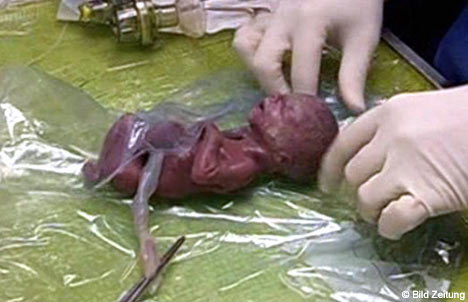
25 week old baby weighing 10oz delivered in Hanover, Germany. She survived against all odds and have been allowed to go home after six months. While not the youngest case recorded, it's the smallest preemie baby I've seen! More here.

It's sad that in many places, Singapore is one of them, the limit for legal abortion is 24 weeks, when it is clearly, obviously, already a baby. (Yeah, it's already a baby since conception, but you can't say that 25-week-old Kimberley Mueller was a blob of tissue.)

Wednesday, September 26, 2007

I believe in Love

If I should ever find myself in doubt and darkness, I shall read again this short but profound reflection on Mercy, drawing from the writings of St Therese of Lisieux, St Paul and the life of Our Lord as written in the Gospels.

The good God would not inspire unattainable desires; I can, then, in spite of my littleness, aspire to sanctity.—St Therese of Lisieux

This page is taken from the 2nd chapter of a personal retreat volume "I Believe in Love" by a French priest, Rev. Jean C. J. d'Elbeé, who wrote it based on St. Therese's 'teaching about confident love'. It may not be unfamiliar to most, but encountering it at this point of my life is nothing less than a caress, an oasis in the desert.

A sampler is here:

I am not telling you, "You believe too much in your own wretchedness." We are much more wretched than we ever realize. But I am telling you, "You do not believe enough in merciful love."

We must have confidence, not in spite of our miseries, but because of them, since it is misery which attracts mercy.

Oh, this word, mercy — misericordia — "miseris cor dare," a heart which gives itself to the miserable, a Heart which nourishes itself on miseries by consuming them. Meditate on this word.

St. Thomas says that "to have mercy belongs to the nature of God, and it is in this that His omnipotence manifests itself in the highest degree."

Little Thérèse perceived this when she wrote these lines which complete and crown her manuscript: "Yes, I sense that even if I had on my conscience all the sins which can be committed, I would go, my heart broken, to repent and throw myself into the arms of Jesus, for I know how much He cherishes the prodigal child who returns to Him. It is not because the dear Lord in His provident mercy has preserved my soul from mortal sin that I am lifted up to Him by confidence and love."

Again, shortly before her death, speaking to Mother Agnes, she said, "You may truly say that if I had committed all possible crimes, I would still have the same confidence; I would feel that this multitude of offenses would be like a drop of water thrown into a flaming furnace." All possible crimes, a multitude of offenses, a drop of water in an immense furnace: that is the proportion.

Wednesday, September 19, 2007

Happiness is...

... a warm electrode, according to modern science :)

The subject has been ill with depression for more than ten years, and did not respond to typical treatment such as drugs and ECT (electroconvulsive therapy). This DBS (Deep Brain Surgery) treatment implanted electrodes that deliver a small, regular jolt of electrical current to an area of the brain 'believed to be a key regulator of mood'. While similar treatment has been done on patients with Parkinson's disease by normalizing the 'activity in the basal ganglia and thalmus—which dictate motor control—thus reducing trembling limbs', this operation is believed to be the first to 'tackle depression'.

The article did briefly mention the ethical concern of allowing this treatment to be performed without much understanding of why the electrical pulses seem to be correlated to mood uplifting, and putting in a mechanical implant that may have to last many decades. The argument given in favor of this treatment is the seeming epidemic of depression; and how time is the enemy of depression patients, having caused many fatalities through suicide (11th leading cause of death in the US, this article says). Notably missing however, is a discussion on the implication of having this implant in a patient's head—both from the risk aspect of mechanical failure or poisoning or contamination, and unforeseen psychiatric & physiological side-effect, since this treatment only picked up in the 1990's, giving only a very brief period to study the safety and the efficacy of such medical treatment.

Also troubling in my opinion, is how happiness (albeit the author meant it with his tongue-in-cheek) has been reduced to a formula delivered through a set of physical treatment. It may not be too long before it is made available to anyone who feels the need of an extra dose of happiness. Lunchtime pick-me-up session anyone?

Tuesday, September 18, 2007

Six years later

I was watching "United 93", the first movie I've seen about September 11th 2001, just a few days before the memorial of six years after this tragedy. The movie is in general well written, and for the first time in my video-watching history, I actually checked out the 'Extras' at the end of the movie. In it (the DVD version), there are many families featured, who have lost someone in that flight, and how they were involved in the making of the movie. That was, I thought, the most touching part and telling, too!

One mother, interviewed in 2005, a year before the movie was released, said something to the effect that she did not know what kind of person her daughter really was until after her death. In a way the tragedy 'opened' her eyes, but she was still grieving for what could have been, what life they could have led together. Many lives were cut short that day, and I too was reminded to count on what really matters in our brief lives. May they rest in peace.

Wednesday, September 05, 2007

Trading truth for consistency?

If there is one thing I found negative about writing online (as in, posting a blog, not to be confused with proper, paid, writing of an online article), it is that there is too much freedom to express half-baked thoughts, or even crumbs and trails of some whimsical ideas which are not meant to convince anyone, nor to convey an idea clearly. In fact, any commenter who suggests that a particular post is too incomplete to stand on its own, or that the poster is just experiencing verbal diarrhoea and is just wasting some electrons, will be told to 'sod off', get his own blog and start rambling away there: precisely affirming that the poster was probably not intending to carry out any form of proper discourse.

(Now, after that long rambling preamble, I'm trying to remember what is the point of this post...) It is therefore very easy to start writing a post, and suddenly lose one's train of thought. (Like the fact that this post was started a week earlier). Sometimes, it's because there's just one bit of idea, which could be a single word, that keeps popping up in the blogger's mind; that s/he comes to the conclusion that there must be a common thread connecting all this 'light bulbs'. Well, living by the rule that since it's my blog, I'll try my best to write on topics that I want (given proper boundaries of sensibilities, of course).

Just this week, we celebrate the memorial of two great saints in the Church: St Augustine, and his mom, St Monnica. The blogosphere is abuzz (rightly) with posts about these two saints every year around this time of their feast days. I read St Augustine's Confessions once, and like someone once said about some works of the saints, it serves as a 'spiritual thermometer' to me... On days when I feel close to God, I could perfectly echo Augustine's words and claim them as my own sentiments. On days when I feel like I'm walking in a shadow, reading those words made me feel empty, their echoes only emphasizing the emptiness of myself. Well, this year it is the latter.

I've been told, many times by different people, that when in doubt, or facing a major decision, turn to Him in prayer. When feeling lukewarm or distant, call out to 'Him who never leaves you if you do not leave him'. I'm just a baby when it comes to prayer, and frankly I don't recall ever receiving a clear 'answer' to a question, or to a doubt, through prayer. Not that this invalidates the importance or the absolute necessity for prayer; for the Church teaches that any supernatural insights are often deceptive: either they come from the evil one, or from our own intellect, or they can be truly divine.

And so, comforted with this idea that praying is not like chatting or talking on the phone to God—it's more like, writing an email, or writing a blog post, somehow someday someone is going to answer you, and from my experience, neither the time nor the content of the responses are predictable—I proceed with trepidation into this 'light' called prayer. Like most 'beginners', I sometimes receive consolations, but was cautioned against expecting them regularly—as if without them the prayer is any less valid—and now am in this stage of getting used to this lack of dialog.

Now, this is where doubt creeps in. Although I am far from humble, I think I have sufficiently accepted that it is not possible for the human mind to perceive Truth, the whole Truth. It should be possible though, to strive towards truth when one looks for consistency. Consistency? Some might say that even if a sequence of logical arguments is consistent, it might still suffer—at the start of the chain—from a logical foundation error. Yet, to my mind it's easier to correct that one error than to set right every inconsistency in the logic chain.

It is consistency that have led me to where I am. If the smallest object we encounter on earth has a human creator, then it is only most probable that there exists a Creator who made the Universe and everything in it, although mathematically speaking there is a smallest chance that Everything might have come from a mere coincidence. That was the cornerstone for me. Everything else follows.

What's going to follow is not a strictly watertight Thomistic argument — so do not bash my head for this: I was pretty merely comforted by its consistency. If we have a creator, it must be a Good Creator, because nature and human being, despite the bad tendencies, are still geared towards order and goodness. Original Fall explains our soft spot for sins, and the theology of salvation makes perfect sense if one believes in the Good Creator. If one believes in St Thomas' argument for the divinity of Jesus Christ, then one believes in His revelation that our God is Trinitarian. And thus that God paid the price of our redemption. And thus one, catholic and apostolic Church as his visible body. And thus the Catholic Church as the one true church. And thus she holds depositum fidei. And thus all her teachings. And when it comes to the Church's teachings on hell and heaven, the sacraments become absolutely necessary. And the real presence in the Eucharist, thus genuflection. And the need to receive worthily, thus regular confession, thus daily examination. You see what I mean?

At the center of this pack of 'cards', lies prayer. And this is where things get a little muddy, because as all you know, prayer is anything but consistent. When one engages in prayer to God, one does not tell God that He needs to answer back in a manner that one demands! I realize that the lack of predictability, the lack of consistency in the manner of prayer was unsettling to me: the crux of the problem. I guess it is the 'weakest link' in the sequence, for how can one reasonably reason prayer and faith? All this while, faith has never been separated from reason for me; but I'm entering a state where faith seems to be above reason.

Can God be consistent? Am I imposing consistency on God? Just because the universe He made seems to follow some rational formula, it doesn't mean it is the only way He acts. I realize this question brushes the transcendental view of God that the Muslims hold, of an omnipotent God who is also totally arbitrary and not bound by the rules He himself set. The problem seems to be a matter of wanting to bind Truth to mere consistency. To want to reduce God into a logical system. To want to bind the Infinite into a finite human mind. "For my thoughts are not your thoughts, neither are your ways my ways, said the Lord." (Isaiah 55:8)

Can Truth be wholly possessed when we are still on this earth? Our soul is made for heaven, yet we can't possess it while still here; it's as futile as trying to hold the ocean in your hands. And yet, is one to be faulted for wanting to possess Truth? "Lord you have made us and drawn us to yourself, and our heart is restless until it rests in you." How true!

At the end of this long rambling discourse, I realize a few things:

- that this entire exercise has been useful only to sort out floating bits of clouds that occupy me these past few weeks,

- that I'm no good at rhetorics,

- that who am I to raise about consistency given my own poor consistency,

- and yet, despite my sins, weaknesses, aridity, lukewarmness or coldness, happiness is having God himself, and that's why we keep stumbling back, blind and grasping most of the time...

Pray that we may not trade Truth for consistency!