
I found out about Bioethics Forum from Dr Ignacio Segarra. He spoke of issues in bioethics using natural law framework with strong Catholic flavor. If any of you reading this are in Singapore, do attend the forum's first session of the year.
I found out about Bioethics Forum from Dr Ignacio Segarra. He spoke of issues in bioethics using natural law framework with strong Catholic flavor. If any of you reading this are in Singapore, do attend the forum's first session of the year.
How is each vacation different? Both I and my sister (who until recently, studied in Singapore as well) always go home for Christmas and New Year. Typically we'd either spent a few happy weeks with our family at home, or go on a road trip to East Java (where my grandparents and numerous cousins live) to spend the New Year at our grandparents' house. So this year's road trip isn't so unlike those in the past.
Yet every vacation gives different things. For instance, this time I got to read cover-to-cover a few books (something I've never been able to do during the past vacations!), I cut my hair short, and I actually completed a small part of an inventory system for my mom's pharmacy! Also, I had a pretty long talk with my grandpa (no mean feat, since he spoke a Chinese dialect which I mostly had to guess & listen to its context to understand what he was saying). The long road trip forced all of us who weren't driving to face the big questions we'd normally defer from thinking about in busy days.
I finally finished reading Woods' How the Catholic Church Built Western Civilization. There are a few short chapters after the long chapters on Science and the University; these are on: Art ('nuff said), Economics, Charity, International Law & Western Law, Western Morality, and finally, a chapter titled A World Without God. Though these chapters were well-written, the sense of being blown away upon their discovery had somewhat lessened after the chapters on Science. These chapters, just like the previous few, focus particularly on the big ideas that the Church helped bring about/nurture and had her role all but denied or misunderstood.
In modern fiction work such as the Samurai by Shusaku Endo (which I just read), the Spanish clergy in the New World were depicted as repressive, manic zealots, or collaborationists in imperial conquest. Woods pointed out that it was Fr Francisco de Vittoria, sometimes called 'the father of international law', who "brought forth the first grand treatise on the law of nations"—considering matters of jurisdiction, ownership and just treatment of fellow human beings in the person of the natives, based on the concept of natural law. This book also gave an ironic context to 'separation of church and state'; where instead of the Church interfering in State, he pointed out to the historical circumstances that spurred the Gregorian reform to draw the line limiting secular authority exercising power over ecclesial matters (especially in officials' appointment).
In the field of Charity, Professor Woods argued that Charity (of the scale witnessed) is a singularly Christian enterprise and that the Catholic teaching, based on Jesus' new commandment to love one another, surpassed ancient Stoicism to contribute to the spirit of charity. In this chapter also I learned that the insitution of hospitals was the fruit of Christian charity, and about the good sense of ancient monasteries who owned land and acted as kind, reliable proprietors.
What do these mean to me, one who is not immediately part of the 'Western Civilization'? The contribution of the Church has been far and their impact deep. Reading the chapter on Western morality, the Church's teaching against infanticide, suicide, adultery, and the need for three conditions to justify starting a war, seems like listening to a message of universal morality. One doesn't need to be Western to realize the evils of those practices prevalent then, but it was the Catholic Church who proclaims the values that necessarily render these practices sinful. My country's laws were based on those of the Dutch, which no doubt has Christian legacy. The schools which I attended were founded by missionaries from Europe.
This post which is supposed to be a reflection from my vacation turns out to be a crude summary of Thomas E Wood's wonderful book. Yet this book gives an inspiration for those who, like me, are discerning upon their vocation in the face of increasingly secular world. He wrote:
"The Church recalls the great men of Christendom—like Charlemagne, Saint Thomas Aquinas, Saint Francis of Assisi, and Saint Francis Xavier to name a few—and holds them up as models for how true men live. Its message? Essentially this: You can aspire to be one of these men—a builder of civilization, a great genius, a servant of God and men, or a heroic missionary"
In his acknowledgement, Woods wrote that he hoped his daughters would find in their Catholic faith a 'pearl of great price', and quoted St Thomas More: "No one on his deathbed ever regretted having been a Catholic."
UPDATE: The first part of comments on Woods' book is here
I've been searching for something exactly like this.
And more links (thanks to the same blog):
Go Swim
USA Swimming
WebSwim
Swim.ee
Swimming Science Journal
The Counsilman Center
Swim Research Center (Amsterdam)
Merry Christmas to all!
I'm home and being with my family is exhilarating enough that I oddly.. don't miss not having access to the Internet all the time :)
I'm still reading How the Catholic Church Built the Western Civilization, and a few other things. I think there's a bit more reflection coming after the vacation is over.
Tomorrow I'm going home to be with my family this Christmas. Home's just an hour half away (plus a few hours of waiting & transiting)... but I've been away for a year now and this song had never been more appropriate.
Going Home— sung by Mary Fahl (featured in Gods and Generals)
They say there's a place, where dreams have all gone
They never said where, but I think I know
Its miles through the night just over the dawn
On the road that will take me home
I know in my bones, I've been here before
The ground feels the same, though the land's been torn
I've a long way to go, the stars tell me so
On this road that will take me home.
Love waits for me round the bend
Leads me endlessly on
Surely sorrows shall find their end
and all our troubles will be gone
And I know what I've lost, and all that I won
when the road finally takes me home
And when I pass by, don't lead me astray
Don't try and stop me, don't stand in my way
I'm bound for the hills where cool waters flow
on this road that will take me home
Love waits for me round the bend
Leads me endlessly on
Surely sorrows shall find their end
and all our troubles will be gone
And we'll know what we've lost and all that we've won
when the road finally takes me home.
I'm going home
I'm going home
I'm going home
Recently I came across the issue of how important is the parents', or rather, father's influence on children's religious beliefs, and how to raise good Catholic kids, thereof.
At the present I'm reading Shusaku Endo's The Samurai and there are similar echoes in my own story of faith too. In this novel, the samurai expressed revulsion at first, later desperation at the thought of embracing a religion alien to his ancestors:
"I can't be the only one in my family to convert to a foreign religion that my father and my ancestors never knew"
"..back in the marshland, everyone shared in the lives of everyone else.. in the marshland, everything was as one.. [he] could not abandon the faith revered by his father.. That would be tantamount to betraying his own flesh and blood, betraying the [homeland]"
Refering to figure of Jesus on the cross:
"This ugly, emaciated man. This man devoid of majesty, bereft of outward beauty, so wretchedly miserable. A man who exists only to be discarded after he has been used. A man born in a land I have never seen, and who died in the distant past. He has nothing to do with me", thought the samurai.
There are 2 separate points here:
1. Influence of parents on the person's conversion
2. Influence of parents on the person's continuing belief (and subsequently, the influence of ancestors on future generation's belief)
"I come not to bring peace, but to bring a sword"
Is the faith of our fathers important for conversion? In some cases, it could be discouraging in the case of Endo's samurai (which he claimed, was somewhat slightly autobiographical!), to break away from thousands of years of tradition. Stripped down to its essence, this could be just a matter of pride; the samurai was impressed by the charitable acts of the missionary, I was convinced by the teachings of the God who lived as man & died for Mankind, yet both of us did not (at first) want to be the first to abandon a practice that had served our ancestors for hundreds of years. Many Catholics I encountered on the blogosphere were mostly Europeans/Caucasians: former cradle Catholics who returned to the Church, or separated brethren who crossed the Tiber. In their cases, in spite of the seeming apostasy, they are able to say that they are returning to the 'faith of their (fore)fathers'.
Is the faith of our fathers really important for continuing belief? I'd often reflected how the Catholic faith is truly meant to be lived in a community, and what better way to start than in your own family! A lot of culture goes into cultivating religious beliefs, hence at times I felt that, being a first generation convert, my own faith lacks that cultural support. Discovering that the Catholic faith goes deep (in terms of practices, devotions and institutions) has helped me personally to provide the weight of history and point of reference. As I discovered many hidden facts about the Church's role in shaping the world and my worldview thus far, I felt a connection to the universal family who shared the same faith all over the world, over time. If ever I were to have children some day, I'd make sure they know their mother's faith doesn't separate them from society in general, but unite them to a great universal civilization born out of Christian faith.
"Late have I loved you, O Beauty ever ancient, ever new, late have I loved you!"-- St. Augustine
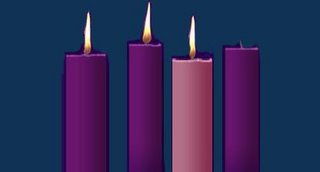
The 3rd week of Advent is associated with the theme of Joy (hence the single rose-colored candle amongst 3 purple ones). At times like these, when I feel nothing but exhaustion at the end of the day, I am eternally grateful for the faith that taught me to keep our eyes of faith fixed on the Light of the world.
Yesterday's first reading (Isaiah 61:1-2, 10-11)
1 The Spirit of the Lord GOD is upon me, because the LORD has anointed me to bring good tidings to the afflicted; he has sent me to bind up the brokenhearted, to proclaim liberty to the captives, and the opening of the prison to those who are bound;
2 to proclaim the year of the LORD's favor, and the day of vengeance of our God; to comfort all who mourn;
and the Gospel reading about John the Baptist proclaiming himself a 'witness to the light' (John 1:6-8), reminded me of the passage in Machabees which liken us to a pan of impure silver under purification over fire, and only when the silversmith (our Creator) can see a clear reflection of Himself in that pan of silver is the process complete.
So through fire we cling on to Him to whom we will come to at the end of this Advent, and at the end of our exile.
This is not quite a book review!
I'm still currently reading this book; it has been a wonderful book so far, though its treatment of major issues is a little superficial. I'd have liked to read more details. Perhaps with a longer time at hand, Professor Thomas E. Woods, Jr. would have made a thorough historical treatise not unlike Harry Crocker's "Triumph". However I'm writing this short note just so that I don't forget a few threads I'd like to research deeper.
In particular, the chapters on "Church and University" & "Church and Science" made it clear that so many prominent scientists were inspired by their faith; and it is no coincidence he pointed out that some luminaries have been monks and priests. What I find incredible is that I've never heard of them! Sure one's heard of a few famous Catholic scientists like Mendeleev and Pasteur. But Fr. Nicolas Zucchi (inventor of the reflecting telescope, who took one to Kepler)? Fr. Macelwane of the field of seismology? Fr. Boscovich who wrote Theory of Natural Philosophy? Fr. Athanasius Kircher? The Jesuit Seismological Service? Perhaps my involvement in science doesn't go deep in those areas, and neither is, I suspect, the average college grad's general knowledge about the history of science. Yet the contrast between the magnitude of their contribution and the relatively scarce credit due to them is so stark.
The Church suffered from an unsavory and wholly unjustified reputation for repression of science. The author spent a large part at the beginning of this chapter just 'clarifying' the Galileo scandal! Few modern-day high school or even college grads are aware of the Church's role in 'depersonalization' of nature, modernizing the approach to enquiry and establishing a discipline called science. I find it extremely interesting that the author made a causal link that the Christian worldview of the ordered, mechanical universe having an intelligent Creator who has the 'complete creative freedom' and yet chose to create a universe that is 'rational, predicatable and intelligible', has inspired science:
(Page 80-81):
[This approach] avoids two potential errors. First, it cautions against speculation about the physical universe that is divorced from experience.
...
Second, it implies that the universe that God created is intelligible and orderly, since God possesses the raw power to bring about randomness and lawlessness in the physical world. (and yet did not!)
and also on page 76, where the author quoted Fr. Stanley Jaki, a historian of science who wrote Science and Creation, that science has suffered a 'stillbirth' in non-Christian 7 'great cultures': Arabic, Babylonian, Chinese, Egyptian, Greek, Hindu and Maya, precisely because of the lack of conducive worldview that made 'formal and sustained scientific enquiry' such a success in Christian Europe—that is, one where the universe is seen as the work of a Creator who 'has endowed [it] with consistent physical laws', in contrast with the view of universe as having 'spirit' and will of its own, 'dominated by a pantheon of deities' who naturally, do not encourage observation and exploration of a regular pattern at work.
Being ethnically Chinese, reading this statement has a profound effect on me. As far as Chinese goes, it only comes to my look. My grandfathers came to Indonesia; both were from the merchant folk, and there's precious scant, if any, worldview prevalent in the family. There is a pantheon of gods, of course, coupled with a strong belief in fate and luck, and science (or pursue of natural philosophy) is nowhere in the picture.
It's getting late, but reading these chapters have definitely stirred a thread of thought.. more on this later.
Beautifully done example of OS-on-the-Internet-browser concept I wrote about some months ago. WOW!